Attend a Course

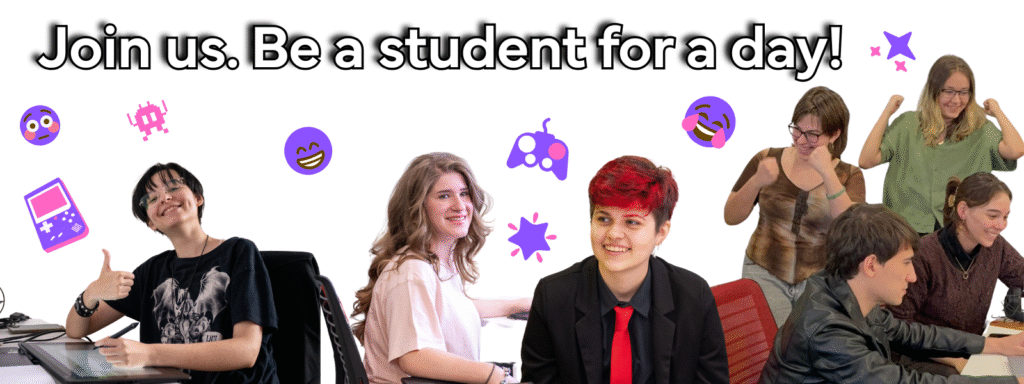
See What It’s Like to Be an ECHO School Student

Learn game development, art, and technology through hands-on projects and real industry guidance.
The ECHO Experience
At ECHO School, students learn by creating: games, digital worlds, and interactive projects. Classes are practical, collaborative, and led by professionals from the tech and creative industries.
You’ll experience:
  • Hands-on learning
  • Small groups & personalized support
  • Modern labs and creative spaces
  • Teachers with real industry experience
What You’ll Study
Explore programs that combine creativity and technology:
  • Game Engineering & Programming – Build gameplay systems and prototypes.
  • Game & Level Design – Create fun, balanced, engaging experiences.
  • Environmental Art & Visual Design – Design worlds, environments & visual assets.
Student Life
Every day mixes creativity with real practice:
Projects in the lab, teamwork, feedback sessions, workshops, and guest talks from game developers and digital artists.
What Students Say
“Here I finally learn things that matter for my future.”
“I stopped just playing games — now I build them.”
“The teachers treat us like creators.”
For Parents
ECHO School prepares students for future careers in technology, design, and game development through practical learning, expert teachers, and a supportive environment.
How to Apply
  1. Fill in the interest form
  2. Meet with us
  3. Visit the school
  4. Complete admission steps
YEAR 1 - TERM 2
Computer Arts and Animation
Media Production

In this module, students will work collaboratively with their peers, as part of a multidisciplinary team, to design and develop an interactive media-based project that makes use of design elements. Individual students will be expected to; make use of relevant development and creative skills to generate elements of a media project; participate in pitching and presentations; hone their communication skills to work effectively within the team setting and present their work clearly; research and test technical pipelines; create project documentation and planning materials; and work, as part of a collective, towards a final interactive piece.

This module will introduce students to 3D asset creation, providing them with the knowledge and skills required to design and build their own 3D assets for games in a production setting. By developing abilities and awareness within the field of 3D art asset creation, students will create their own strategies for independent learning within this broad subject area.

This module will ask students to build upon foundational concepts for animation and focus on developing the skills and knowledge necessary to create rich, engaging, and unique character personalities for games or film. This will include studying the principles of personality design and storytelling, as well as learning advanced techniques for creating character performances that are believable and emotionally resonant. Students will also learn how to create character animations for games, including the unique challenges and requirements of game animation, such as working within the constraints of real-time rendering. Through a series of hands-on projects, students will have the opportunity to apply their skills and create their own character animations that are rich in personality, emotionally engaging and considerate of context. The goal of the course is to help students become proficient in creating high-quality character animations that are both fit for purpose and emotionally compelling.

Media Production

In this module, students will work collaboratively with their peers, as part of a multidisciplinary team, to design and develop an interactive media-based project that makes use of design elements. Individual students will be expected to; make use of relevant development and creative skills to generate elements of a media project; participate in pitching and presentations; hone their communication skills to work effectively within the team setting and present their work clearly; research and test technical pipelines; create project documentation and planning materials; and work, as part of a collective, towards a final interactive piece.

Operating at the intersection of graphic visual communication design, interaction design, and user research, User Interface (UI) and User Experience (UX) designers hold significant responsibility within game development teams and digital design studios. This module provides an opportunity for students to develop their knowledge, understanding, and skills in UX design, whilst also developing their applied knowledge and understanding of underpinning theories and methodologies.

In this module students gain an understanding of the game development lifecycle, management of game development based on Project Management Frameworks and Software Development Frameworks and the management of live games or games offered as a service.

Data Structures and Algorithms 2

This module builds on Data Structures and Algorithms 1 by introducing students to parallel programming on shared memory and GPU architectures and the design
techniques underpinning parallel applications, using a range of case studies drawn from typical real-world applications.

This module builds on Graphics Programming, Data Structures and Algorithms 1 and Computer Architecture and introduces the necessary components needed to develop a 3D physics-based game application considering the hardware.

This module provides an introduction to the principles of 3D graphics programming. Students will develop application that demonstrates real-time 3D graphics.

Computer Arts and Animation
Multidisciplinary project

For this module, students will be required to work together on an interactive media project as part of a multidisciplinary team. Individual students will be expected to contribute to their team by taking on a professional role suited to their area of study. As part of the module, all students will be expected to: communicate with clients and relevant stakeholders; participate in pitching and presentations; research and test technical pipelines; create project documentation and planning materials; and contribute to the iterative design and development of a final interactive prototype.

Multidisciplinary project

For this module, students will be required to work together on an interactive media project as part of a multidisciplinary team. Individual students will be expected to contribute to their team by taking on a professional role suited to their area of study. As part of the module, all students will be expected to: communicate with clients and relevant stakeholders; participate in pitching and presentations; research and test technical pipelines; create project documentation and planning materials; and contribute to the iterative design and development of a final interactive prototype.

Multidisciplinary project

For this module, students will be required to work together on an interactive media project as part of a multidisciplinary team. Individual students will be expected to contribute to their team by taking on a professional role suited to their area of study. As part of the module, all students will be expected to: communicate with clients and relevant stakeholders; participate in pitching and presentations; research and test technical pipelines; create project documentation and planning materials; and contribute to the iterative design and development of a final interactive prototype.

Fill out the registration form:

Echo School - Attend a Course Term2

Founding Partners

Bism logo
Amber logo

Academic Partner

Alberta University logo